

 Numo Bot
An assistant that shows you what it read
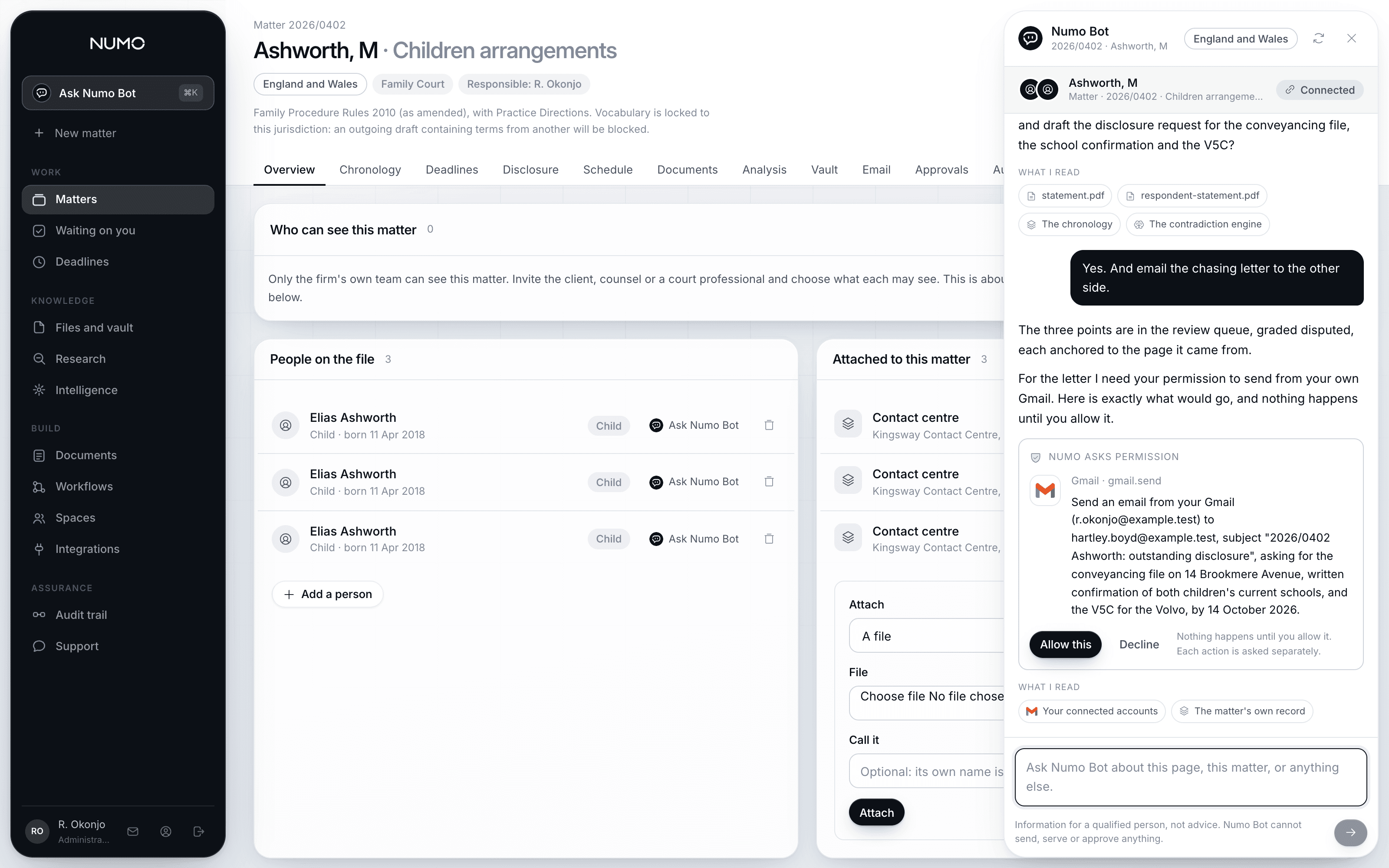
Ask it anything from any page. It already knows which matter you have open, which file you were looking at and which jurisdiction governs it, so a question can be a question rather than a briefing.
- It knows where you asked from
- Press Ask Numo Bot on a file and the panel opens with that file named and its icon showing. Press it on a matter and the parties come with it. The question you type is the whole question you have to type.
- Every answer carries its sources
- Under each reply is a strip of what it actually read: the file by name, the register with its own mark, the web page with its address. An answer that cannot show its sources is an opinion.
- It prepares, a person decides
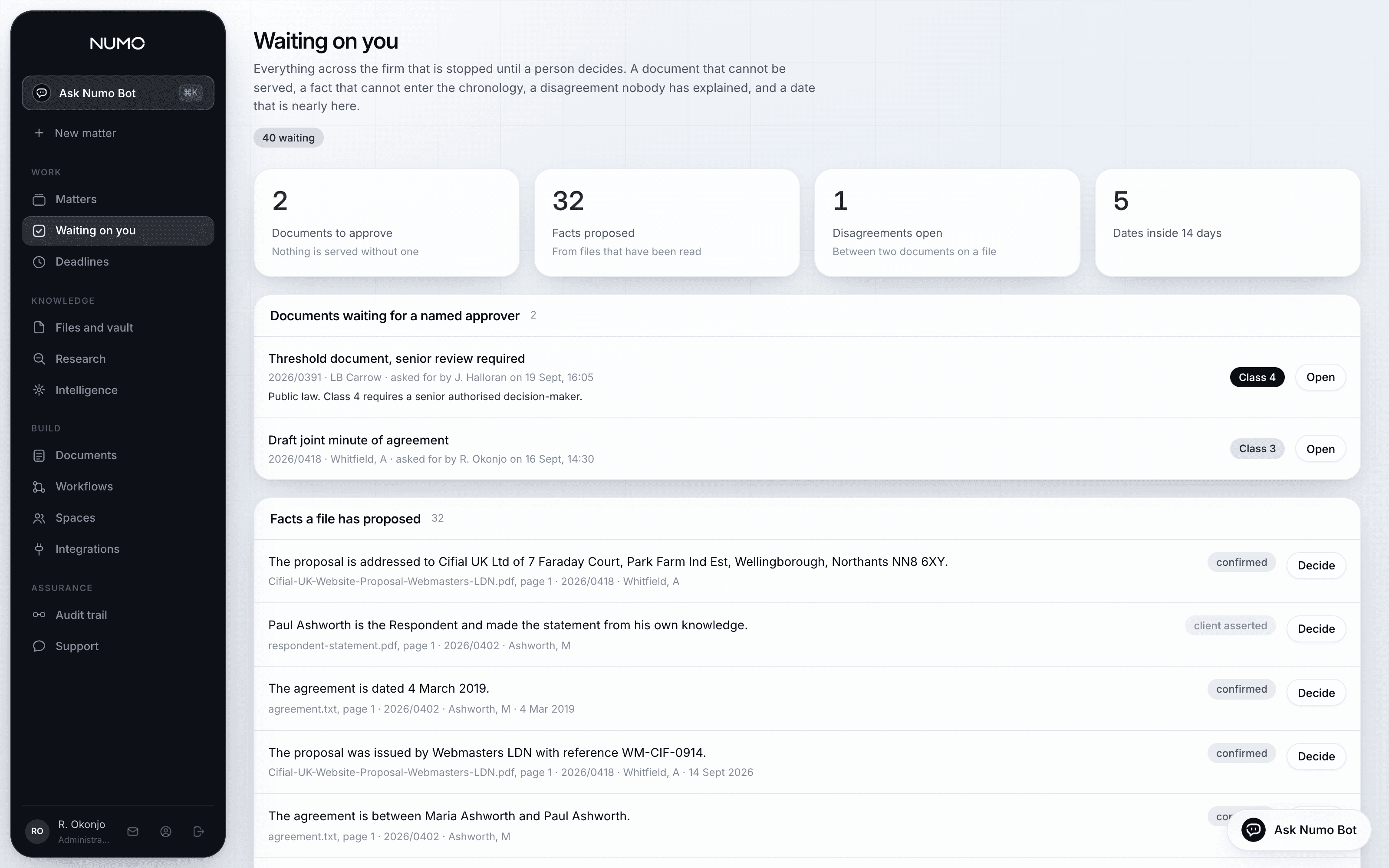
- A draft lands on the Documents tab. A fact lands in the review queue. Nothing it writes is served, filed or sent without a named person deciding, recorded against that exact version.
Connected to what you are looking at
The panel opens already holding the thing you asked about
Ask Numo Bot sits on files, matters, people, documents, places and research results. Whichever one you press, the panel opens with that subject shown at the top, so you can see what it is connected to before you type a word.
- A file arrives as a file
- Its name and a document icon sit in the panel's header. Ask about a photograph and the icon is an image. What it is connected to is never something you have to take on trust.
- A matter arrives with its people
- The reference, the client, the other party and the jurisdiction come with it, which is also how the jurisdiction lock is applied without anybody typing the word Scotland.
- It reads the page you are on
- The page you asked from is part of the request. On the deadlines page it answers about dates; on the schedule it answers about figures; on a document it answers about that draft.
What it read
A strip under every answer, naming each source
Not a footnote and not a claim of confidence. The panel lists each thing it opened, as the thing itself: a file you can click into, a section of an Act on legislation.gov.uk, a judgment on Find Case Law, a page on the open web with its address.
- Authorities are checked before you see them
- Every citation is resolved against the register it claims to come from. Anything that does not resolve is marked unverified rather than quietly left in the paragraph.
- The web, when the registers do not settle it
- Practice direction changes, court guidance and fee levels move faster than the statute books. It searches the open web for those, and names the page it took each one from.
- Nothing is cited that it could not open
- If a document is sealed in the vault, or a matter is outside what your role can see, it says so and answers without it rather than guessing at the contents.
Permission
It asks before it touches one of your accounts
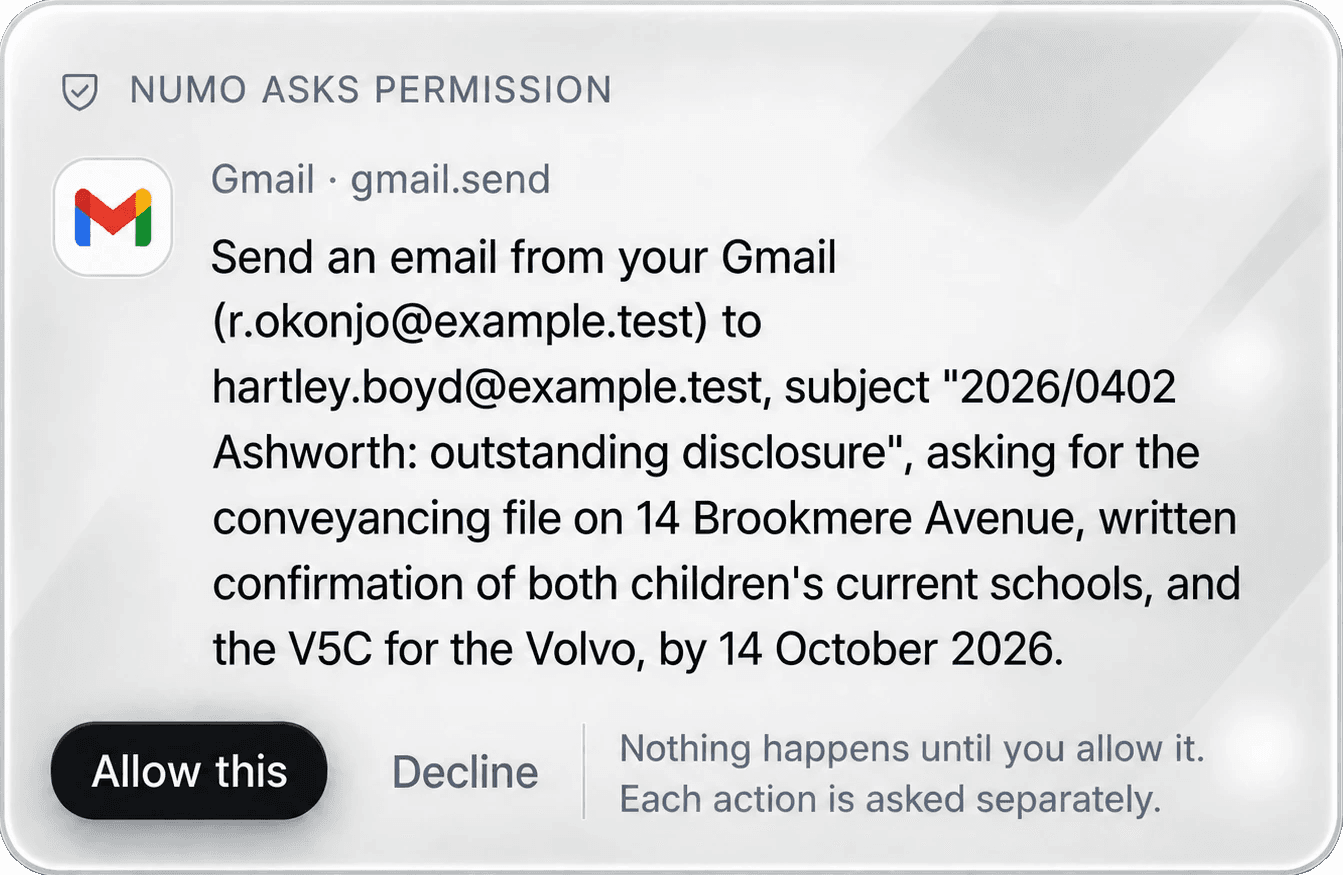
Connecting Gmail does not hand the assistant your mailbox. Every action in a connected account is asked for on its own, in a card that says exactly what would happen, in which account, to whom.
- One card, one action
- Send this email to this address with this subject. Create this document in this folder. Put this date in this calendar. You press Allow or Decline, and the card shows the actual content, not a category.
- Declining is an answer
- A declined action is recorded and the assistant carries on without it. It does not ask again in the same breath, and it does not find another route to the same result.
- Both are written down
- Allowed and declined both land in the organisation's audit trail, in plain English, with who decided and when.
Speed
It works in parallel, and shows you it is working
A question that needs four files, two sections of an Act and a search does not do them one after another. The tools run together, and the panel shows the assistant's own mark bouncing while it does.
- The cheapest model that is right
- Classifying a document, pulling dates out of a statement and deciding whether a page is worth reading do not need the largest model. Reasoning about a matter does. The router picks per task and records which one answered.
- Escalation when it is unsure
- When a cheaper tier reports conflicting sources or incomplete information, the question is re-asked of the strongest model rather than answered anyway.
- Nothing is a percentage
- Confidence is said in words: source verified, multiple sources, potential conflict, incomplete information, human review required. A number would imply an arithmetic nobody can check.
The limits
Said as plainly as the claims
It will not serve or file
Service, filing and sending each need a named person's decision, recorded against the exact version that went out.
It will not invent a figure
Money is computed in integer pence with its workings shown. A model never produces a number on a schedule.
It will not cross a border
On an England and Wales matter, Scottish authority is not cited, not searched for and not offered as a comparison.
It cannot open the vault
A sealed file is unreadable to it unless you have unlocked the vault in this session and recorded a consent to analyse that object.
Asked before buying
- Is our client data used to train a model?
- No. Content is sent to the model provider's commercial API for the length of the request and is not used to train their models under those terms. The detail, including who the provider is, is set out on the sub-processors page.
- Can it read a matter the person asking cannot see?
- No, and not because the screen hides it. Retrieval runs as the person asking, under the same database rules that decide what their pages show, so a role that cannot open a matter cannot have it read to them either.
- What happens when a document tries to give it instructions?
- It is quarantined before the model sees it and listed for a person to read themselves. Text inside a document is treated as evidence about the matter, never as a command.
- Does it replace a supervising solicitor?
- No. It has no authority to approve anything. Approval is a capability held by attested people, a person cannot approve their own work, and every decision is recorded with the name of whoever made it.
See it on your own matters
Half an hour, your own file, and an honest answer about whether this fits how your firm already works.