

Documents and signing
Made from a registry, signed by a hand
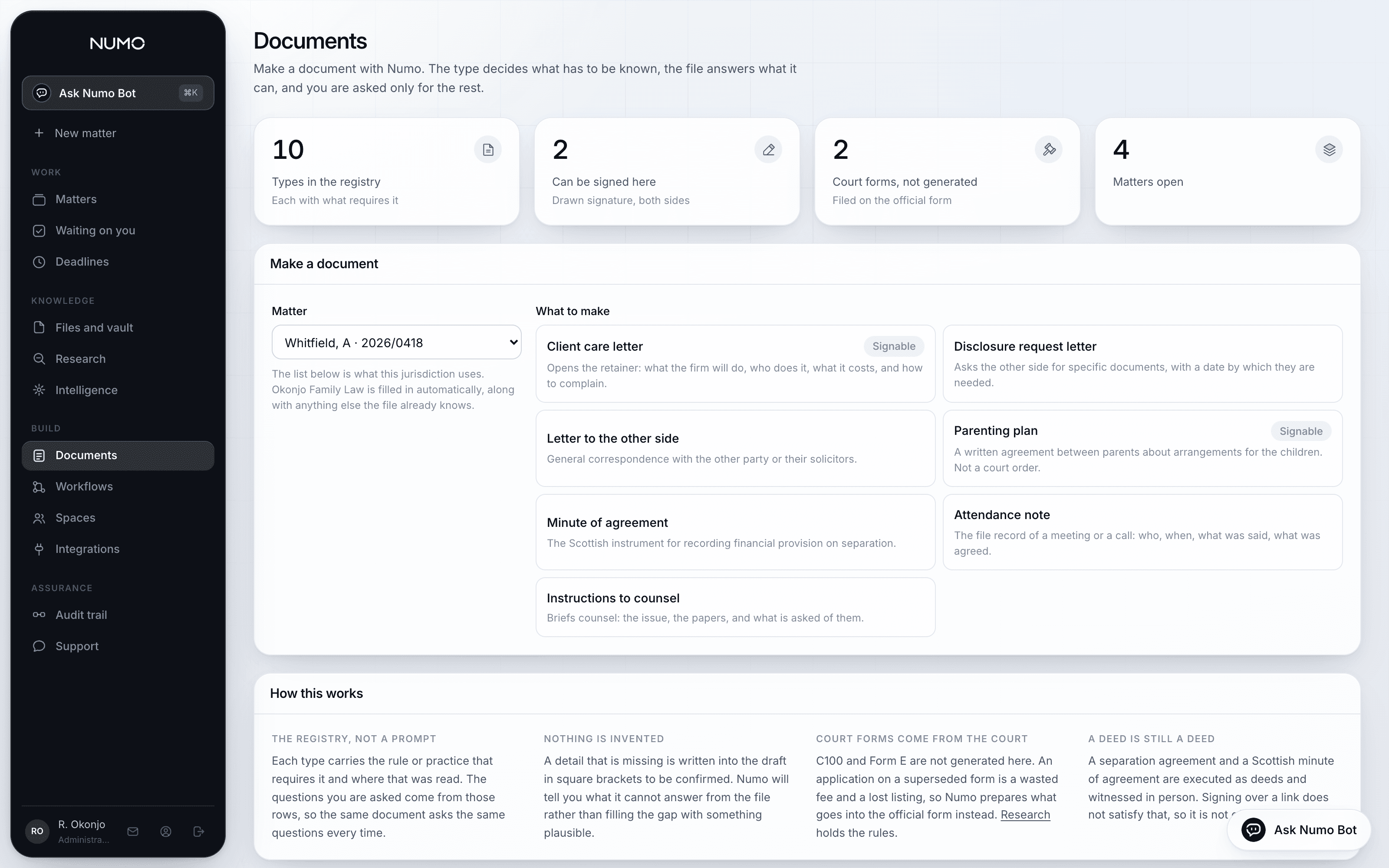
Each document type carries what requires it, where that requirement was read, who checked it and when. The questions you are asked come from those rows, and anything the matter cannot answer is marked to be confirmed rather than invented.
- The questions come from the rules
- Not from a prompt. A separation agreement asks about independent advice and disclosure because those rows exist in the registry, with the authority for each one recorded beside it.
- Both sides draw their signature
- Over a secure link, on a phone or a laptop, with a finger or a mouse. A typed name is not a signature, so the product does not offer one.
- What is recorded is said first
- Before anybody signs, they are told what will be kept: the date, the time, and the address they are signing from. Nothing is captured that the signer was not shown.
The registry
No template is switched on until somebody has checked it
Each document type holds its legal basis, the official source, the date that source was read, the version, and the name of whoever verified it. Until those are filled in, the type is marked unverified and cannot be used.
- Requirements, not fields
- Each row says what the document needs, where that comes from, and whether the matter already holds it. The tab of questions you are asked is generated from the rows the matter cannot answer.
- Execution is part of the type
- Signature, witnessed deed, or the court's own seal. A type executed as a deed does not offer electronic signing, because a link would not make it a deed.
- Three jurisdictions, three registries
- A minute of agreement in Scotland, registrable in the Books of Council and Session, is a different row from an English consent order, with different requirements and a different route.
Drafting
Filled from the matter, not from a plausible guess
What the matter already knows is put in and labelled with where it came from. What it does not know becomes a question. What nobody can answer yet becomes a visible placeholder, never a plausible-looking invention.
- Every paragraph can say where it came from
- A figure traces to the document and page it was read from. A date traces to the fact it was confirmed against, and to the person who confirmed it.
- Nothing goes out unapproved
- A draft carrying an unverified authority or another jurisdiction's vocabulary cannot pass the gate. Approval is a decision by an attested person, and nobody approves their own work.
- Out to where you work
- A finished document can be written into Google Docs on your own template, kept as a file on the matter, sealed into the vault, or downloaded as a PDF on the firm's letterhead.
Signing
A link, a drawn signature, and a record that stands up
The invitation goes out by email to the address on the matter. The link opens the document itself, in full, before anything is asked of the signer. Both sides sign the same way.
- Read before signed
- The whole document is on the page, not a summary with a button under it. The signature panel does not unlock until it has been opened.
- The notice comes first
- "We record the date, the time and the internet address you sign from" is shown before the pad, not buried in a footer afterwards.
- Into the audit trail, in English
- Sent, opened, signed and completed each land in the organisation's log as a sentence a person can read: who, what, when, from where.
- Finished as a PDF
- When the last person signs, a PDF is written with both signatures, the times and the addresses, and filed on the matter. It can be sealed into the vault in the same step.

The limits
Where electronic signing stops
Court forms come from the court
C100 and Form E are not generated here. An application on a superseded form is a wasted fee, so Numo prepares what goes into the official form instead.
A deed is still a deed
A separation agreement executed as a witnessed deed is not offered for link signing, because that would not satisfy the formality.
Never a court order
Orders are sealed by the court. Nothing in the product pretends otherwise.
Identity is not proved by a link
A link proves who had the link. Where identity matters, verify it the way your firm already does and record that on the matter.
Asked before buying
- Is an electronic signature valid in England and Wales?
- For most contracts, yes, and the Law Commission's 2019 report confirmed it. The exceptions are the ones the product refuses: deeds needing a witness, wills, and anything with a statutory form. That is why execution is a property of each registry row rather than a global setting.
- What does the signing record actually contain?
- The document as signed, the drawn signature of each party, the date and time of each signature, the internet address each came from, and the hash-chained audit entries. It is produced as a PDF and kept on the matter.
- Can we use our own templates?
- Yes. A firm uploads its own Word templates and letterhead, and the fields are filled deterministically from confirmed matter data before any prose is drafted.
- Who sends the invitation?
- It is sent from the firm's own transactional email account, so it arrives from the firm rather than from a product the client has never heard of.
See it on your own matters
Half an hour, your own file, and an honest answer about whether this fits how your firm already works.